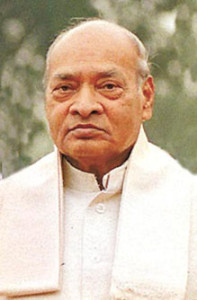
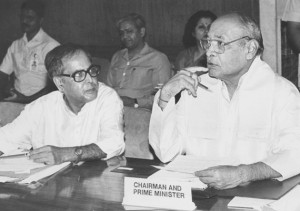
(FILES) In this picture taken 25 March 1995, Sri Lankan President Chandrika Kumaratunga (L) Indian President Shankar Dayal Sharma (C) and Indian Prime Minister P.V. Narashima Rao (R) in New Delhi. Former Indian Prime Minister P.V. Narasimha Rao, who helped transform India's economy in the 1990s, died 23 December 2004, two weeks after suffering a heart attack, the speaker of the national parliament said. The 83-year-old who was hospitalised 08 December 2004, launched India on the path of economic reforms in 1991, having brought in the present Prime Minister Manmohan Singh to head the finance ministry. AFP PHOTO/RAVEENDRAN/FILES

Narasimha_Rao_u7484

“Narasimha Rao ka yehi Vaada, Baten kum, Kaam Jyaada”. This roughly translates to: Narasimha rao promises to talk less and do more. It was on a billboard that I spotted during one of my visits to India in 1993.

Narasimha Rao served as a Prime Minister of India from 1991 to 1996. No sooner he became the Prime Minister he inducted Manmohan Singh, a lifelong bureaucrat, as his finance minister.

Manmohan Singh in his first budget speech in 1991 announced a new economic policy that heralded a new direction for India. He essentially set the Industrial sector free to pursue its own priorities without having to get a license from the government. It was an almost complete renunciation of the policies pursued by various Congress party governments till then. Narasimha Rao was a quintessential congressman who had served under both Indira Gandhi and Rajiv Gandhi. So this change in direction was totally unexpected. There were no further changes during rest of his term. After some initial turbulence and resistance,  mostly from industrialist who had enjoyed protected markets, Indian economy started to show some life and growth rate steadily picked up to unprecedented levels.

Narasimha was vilified by the party but he stood his ground. The party took the credit for the growth but never acknowledged Rao’s contribution. Manmohan Singh was cheered as the hero of the policy change.

With this one act Narasimha Rao freed up the animal spirits of Indians and India has seen almost 25 years of growth. Per capita income has grown almost 8 fold. India is now world’s fastest growing economy.

For this I rate Narasimha Rao 9 on the scale of 1 to 10.
 

1995 was the year of the Internet – the start of the Internet as we know it now. By the end of 1994, Mosaic (later to be renamed as NetScape) browser was available and DNS service had simplified the URLs. Until then it was mostly used by companies and universities to do email and file transfers. It was a crude but very useful tool – although not ready for prime time. Most people used Internet at the office or dialed office to get on the Internet from home. Incidentally modems of that vintage were lightning fast: 9600 baud (roughly bit per seconds). I had started with modems at 300 bauds way back when. Most of the eighties they were 1200 baud. Most communication was textual. 9600 bauds meant that 800 characters transferred per second. Today’s home connections are easily 1000X. My home connection now downloads at 50 MBS (million bits per second)!

1988 Started with the stock marked still depressed, but off the bottoms it had hit in the year before.

For Excelan, the year started with an internal scandal. Our CEO was going through a rough patch in his marriage and was in the process of divorcing his wife. He got involved with one of the female directors of sales. The company was riven with rumors, but he privately assured me that there was nothing to those rumors. I received some pretty explicit photos in the mail, to this day I don’t know who sent them.

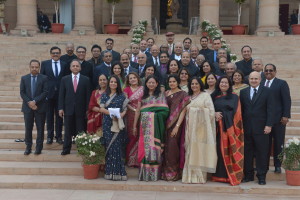
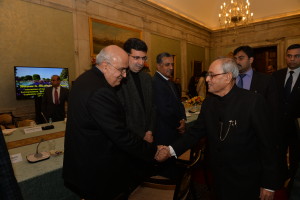
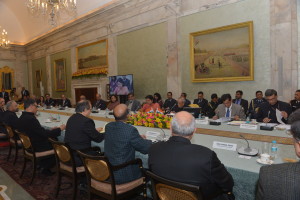
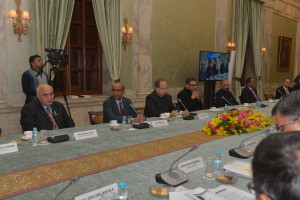
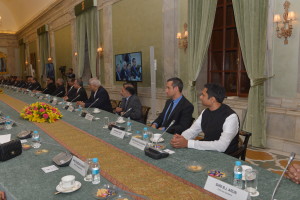
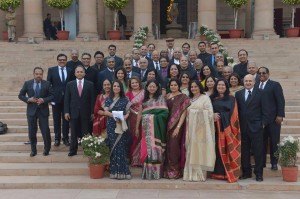
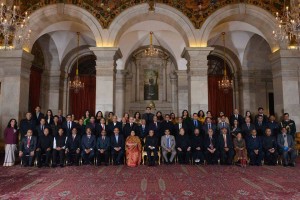
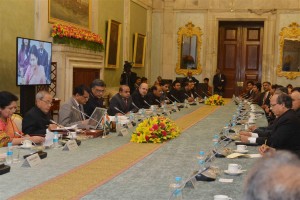
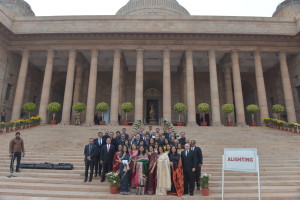
TiE delegation had a visit with President Mukherjee on the 15th evening.

Pranab Mukherjee had been a part of Mrs. Gandhi’s cabinet almost from start and was the finance minister for most of that time. He was the chief architect of her anti-market agenda. He was responsible for single handedly destroying the confidence of international investors in India when he changed law retroactively to override supreme court’s decision against the government in the Vodafone case in 2012. This resulted in the collapse of Rupee in 2013 and probably contributed to the defeat of Congress in 2014 elections.

President was contrite for his mistakes and admitted that they had backed losing policies and had doubled down when they did not work. He probably had not read Hayak’s “Road to Serfdom”. He said he would do it differently if he had a chance to do it again. He talked about entrepreneurship and market efficiencies. He talked about investing in people and betting on their aspirations.

Reminded me of a Hindi saying; ” Nau sau Chuhe kha ke billy Haj to challi” ( having eaten 9 hundred mice, cat is finally going to Mecca for a Haj). I guess the english equivalent would be “a death-bed conversion”.

I was nevertheless taken aback with his candidness and sincerity. Almost felt sorry for him.

Here is a link to YouTube Video taken by them: https://www.youtube.com/watch?v=fRvMCaSqlMg

RA4_1893 RA4_1895 GR4_9697 RA4_1965 RA4_1976 RA4_1981 Rashtrapati Bhavan Group Photo 1

Rashtrapati Bhavan Group Photo

RPB